Short answer: Most homeowners should not attempt to move a hot tub themselves. The risks to people, property and the spa are substantial, and the costs of kit hire, damage and delays often exceed a professional quote. If you want a safe, insured move with the right equipment and planning, use a specialist. See South East Hot Tubs’ professional hot tub relocation service for expert help across the South East and wider UK.
Decide if DIY is realistic
Most portable spas weigh several hundred kilograms when empty. A typical four to six seater is often around two metres square and 85 to 95 centimetres high, with the weight centred in the base. That makes them awkward to turn, hard to control on slopes and surprisingly easy to damage if the route has tight corners, steps or soft ground.
A straightforward DIY move usually involves a flat route wide enough for the spa on its side, a small number of gentle thresholds, and a short, safe load into a suitable van or trailer. Anything more complex calls for specialist kit or a different approach. In practice, that means most real-world moves are better handled by professionals who can assess access, bring the right equipment and manage load control.
The main risks are injury from manual handling, cabinet or shell damage, cracked pipework, scuffs to floors and walls, and transport movement that strains the structure. Electrical safety is another factor; hard-wired tubs must be isolated and reconnected by a qualified electrician. Where access is tight, lifts are high, or the garden is awkward, professional movers are normally the safest and, in many cases, the cheapest option once you account for equipment hire and the cost of a mistake.
Consider handing it over if any of these apply:
- Narrow gates or turns with minimal clearance
- Steps, steep slopes or soft ground along the route
- Large or heavy spas, including swim spas
- Obstacles requiring a lift over walls or garages
- No suitable vehicle or safe tie-down points
Route planning and measurements
Good planning makes any move safer. It also reveals when DIY is simply not viable. Start by confirming the spa’s dimensions from the manual or by measuring the cabinet. You need width, depth and height, plus any protrusions such as control panels, corner mouldings and handrails. When the tub is stood on its side, the length becomes the larger of the two plan dimensions, and the height becomes the cabinet height. That shape, with a little tolerance, must pass through the tightest part of the route.
Now measure the whole path, not just the obvious pinch points. Check:
- Gate openings, alleyways and doorways at the narrowest point between posts or frames
- Corners where the tub will need to rotate while on its side
- Eaves, gutters and low branches that reduce headroom
- Ground conditions, including gravel, grass, decking gaps and soft spots after rain
Allow extra space for the moving gear and the people guiding the load. It is common to need a few additional centimetres beyond the tub’s nominal size because of protective boards, straps and the curve of a turn. If a corner looks questionable, mock the turn with a piece of timber cut to the tub’s length to see whether it will swing without catching. If it will not, do not force it; book a professional relocation.
For paths across gravel or lawn, plan to lay plywood sheets or stout boards to spread the load and stop wheels from sinking. If you must use a public pavement or road for part of the move, consider parking permissions, daylight and visibility, then plan a safe, supervised crossing. If any of this feels marginal, it is a clear sign to bring in specialists who do this daily.
Preparation before you move
Drain the hot tub completely the day before, allowing time for residual water to run from the pipework and shell. Most tubs have a drain point near the base and a hose connection. Direct the water to a suitable drain, then sponge out the last puddles to keep the load as light and dry as possible. Remove filters and loose accessories, and secure the cover with its straps. If the cover lifts off easily, transport it separately to prevent wind damage.
Isolate power at the outdoor isolator or consumer unit. For a 13-amp plug-and-play spa, unplug it and coil the lead. For hard-wired 32-amp or similar connections, a qualified electrician should disconnect before the move and reconnect at the new address. Never work on live circuits, and never energise pumps or heaters until the spa is refilled and bled of air.
Check the destination base is ready now, not on the day. A spa needs a firm, level, load-bearing surface such as a concrete slab, a stone patio of suitable thickness or a properly engineered deck. A soft or sloping base makes final positioning hard and encourages shell and cabinet stress over time. If you are unsure whether the base is appropriate, pause and seek professional advice before proceeding.
Protect the access route. Lay boards over soft ground, remove hazards at hand height along fences and walls, and pad sharp corners indoors. Moving blankets or thick cardboard prevent scuffs where clearance is tight. If this level of preparation is not practical at your property, a professional move is the right route.
Equipment for a straightforward move
You can move a small spa with the right basic kit, kept under control throughout. For a simple route, the most useful items are a spa sledge or a piano dolly with an appropriate load rating, heavy-duty ratchet straps and lifting straps, plywood sheets or scaffold boards for soft or uneven ground, moving blankets with edge protection, and a suitable van or trailer with proper tie-down points. If you do not already own this equipment, hiring costs can add up quickly. Ensure load ratings exceed the spa’s weight and check your vehicle’s payload and towing limits before you commit.
It is worth stressing that equipment alone is not enough. Control, load management, knowing where not to strap, and how to negotiate steps and cambers without twisting the shell all come from experience. Professionals bring both the gear and the judgement, and they carry the right insurance if something unexpected happens.
Moving day, step by step
This sequence explains how a controlled move is managed. It is for awareness, not an encouragement to attempt a risky DIY job. If your route is anything other than flat, wide and short, book a professional hot tub relocation instead.
Start with a briefing. Walk the route with everyone involved and agree on hand signals or simple voice calls. Designate a leader at the heavy end and a spotter who watches for snags and hazards. Clear the pets and bystanders from the work area and keep the space calm. Gloves and sturdy footwear are essential.
Position the sledge or dolly beside the tub. Protect the cabinet with blankets where straps will sit, then stand the spa onto its side in a controlled manner using legs, not backs. Keep fingers well clear of pinch points. Some tubs are more stable on the equipment side, so check the balance before you let go. Strap the tub securely to the sledge or dolly, tightening gradually and evenly so you do not deform the shell.
Move slowly along the prepared path. Short, deliberate pushes keep the load under control. Where there is a single step, build a short, shallow ramp from boards and climb squarely, never at an angle. Use extra hands as counterweights on slopes. Pause at corners and rehearse the turn before committing. If the ground feels spongy, add more boards to spread the load.
Load the vehicle with a controlled lift or ramp. Many movers prefer to keep the tub on its side against a padded wall, then strap in multiple directions to solid tie-down points. Straps should take the load, not just prevent rattle, and they must not cross delicate items like topside controls. Add chocks or blocks to stop any rocking. Close and lock the vehicle and make sure nothing can shift in a hard brake.
Drive gently, avoiding harsh manoeuvres. Take wider turns, increase following distance and reduce speed for bumps. At the destination, reverse the process. Lay boards first, then release straps in a controlled way and move off the vehicle with the same care.
Set the spa on its base and check for level in both directions. An uneven base makes the operation noisy and can stress the cabinet and frame. If the base is slightly out, minor adjustments with packers under the cabinet skids can help, but do not twist the shell or leave high spots under single corners.
If any part of this process feels uncontrolled or if your access throws up complications, stop and arrange a professional move rather than pressing on.
Access challenges and safe solutions
Steps and slopes change the physics. A low, single step is often manageable with a ramp and extra hands. Multiple steps or steep gradients usually call for a winch, a controlled haul line or a rethink of the route. Do not attempt to muscle a hot tub up a flight; the risk to people and property is too high.
Gravel and lawn sections need load-spreading boards. Keep boards tight and stable, avoid leaving gaps where a wheel can fall, and reposition boards in leapfrog fashion as you go. After rain, assume soft ground and increase the number and thickness of boards.
Narrow gates, pinch points and tight turns are where many DIY moves go wrong. If the clear width is less than the spa’s on-side height with tolerances, no amount of angling will make it fit. Removing a fence panel can be safer than forcing a turn that risks cabinet damage. Measure and plan the temporary removal properly so you can reinstate it afterwards without drama.
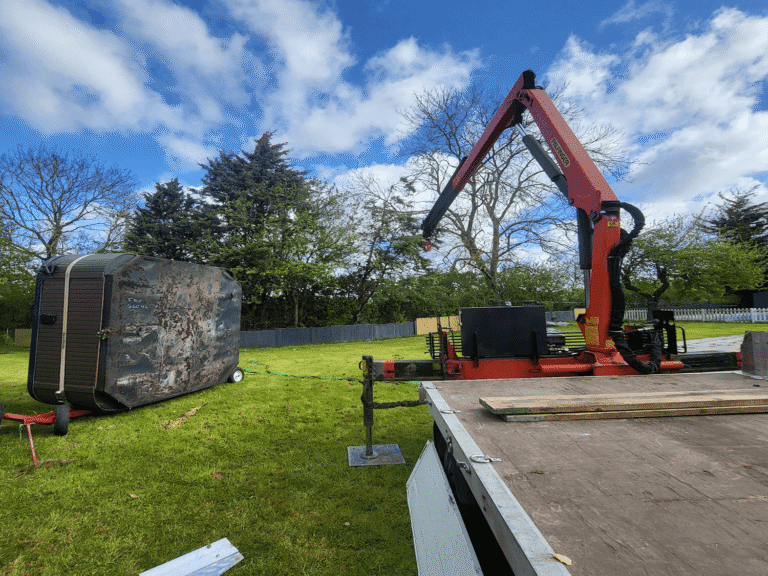
Over-height obstacles like garage roofs, low eaves and high walls sometimes require a lift. Loader cranes, often referred to as HIABs, and mobile cranes allow a clean, safe lift over the obstruction when ground conditions and access allow. Lifts require planning, correct slings and a clear landing area. When the only safe route is over, specialist movers manage permits, coordination and the lift itself. For expert assessment and a safe plan, use our professional hot tub relocation service.
Swim spas and very large tubs are a different category. Their weight, length and flex characteristics demand specialist handling. Treat these as professional moves from the outset.
Transport and load security
Use a vehicle rated for the job. A Luton van with a tail lift or a braked trailer with an adequate payload works well for many portable spas. Check the gross vehicle weight, axle loads and, for trailers, the towing vehicle’s maximum braked towing capacity. Under no circumstances should the load exceed any rating.
Inside the vehicle, line the walls with moving blankets and use timber blocks or foam pads to stop contact damage. Place the spa so that its weight sits over the strongest part of the deck, often centrally between axles. Strap the tub with multiple independent ratchet straps to fixed anchor points. Tighten evenly and recheck after a short distance, as straps can settle.
Avoid wind loading. Carrying a spa upright on an open trailer creates a large sail area. If you must use an open trailer, keep the profile low and use additional straps and padding to resist gusts. Regularly recheck tie-downs on long journeys and at each stop. If any of this sounds marginal with your vehicle, it is safer and usually more cost-effective to hire professionals who bring the right transport and the insurance to match.
Positioning and commissioning at the new home
Before you remove the moving gear, confirm the final orientation, service access side and distance from walls, fences and planting. Leave space around the service panel for future maintenance and safe working. Position the steps and cover lifter so the lid can open fully without hitting a wall or hedge.
Confirm the base is level and load-bearing. Concrete slabs, properly laid stone patios and engineered decks are typical choices. Avoid bare soil, loose gravel and thin paving. If the tub rocks, address the base rather than forcing the cabinet to conform.
Only after the spa is in place should power be reconnected, and that must be carried out by a qualified electrician for hard-wired supplies. Refit filters, fill through the filter well to help purge air from the pumps, and open any valves that were closed. Once full, check for drips around unions and the drain, then power on and bleed any remaining air from the pumps as per the manufacturer’s instructions. Heaters must never be energised without water flow. If you prefer a professional health check after a move, book our hot tub servicing and maintenance service at South East Hot Tubs for a thorough post-move inspection and setup.
Time, hidden costs and risk
A simple DIY move with two to four capable adults, a short route, and a suitable vehicle may take half a day, plus preparation and setup. Once you add equipment hire, protective boards, vehicle fuel, insurance considerations and a contingency for damaged panels or flooring, the total can approach or exceed the price of a professional move. Factor in the value of your own time, the stress of coordinating everything, and the cost of errors that specialists avoid through routine. If you decide to remove an unwanted spa completely instead of moving it, see our hot tub disposal service for safe, insured removal.
Transport insurance and public liability cover are also relevant. Standard car or van policies often exclude cover for damage to items in transit that you are moving for a fee or reward, and they may not cover damage to property caused during loading or unloading. Professional movers carry appropriate cover and have procedures in place that make claims less likely in the first place. If you cannot clearly confirm insurance and liability for every stage, do not DIY the move.
Professional relocation is the safer choice
If your route involves steps, slopes, narrow gates, soft ground, or any kind of lift, the safest and most cost-effective option is to book specialists. A professional team brings the right moving kit, experience with access planning, insured transport and the calm control that comes with doing this every day. For complex moves, cranes and loader cranes are arranged as part of a planned method, with clear responsibilities and timings so the job runs smoothly.
For readers who want expert help, South East Hot Tubs provides a fully insured service covering collection, transport and precise placement, including assessment for restricted access and crane lifts. Learn more about their approach and coverage on the dedicated page for their professional hot tub relocation service. If you are ready to get pricing and availability, request a free quote via our contact page.
Practical examples to guide your decision
Small garden move with easy access: A compact four seater, a straight 1.2 metre side path and a level patio base waiting at the far end. With a spa sledge, boards over a short gravel patch and a couple of ratchet straps, a careful team can complete the move in a few hours. The main watch points are protecting fence posts on the way through and checking the level at the new base. If this still sounds like a stretch, it is perfectly reasonable to book a professional team.
Typical semi-detached with a narrow side gate: The tub measures roughly two metres square and 90 centimetres high. The gate opening is 88 centimetres at the posts. On its side, the spa will not fit with protection, so temporarily removing one fence panel and the gate post is the safe route. Once reinstated, there is no trace of the access solution, and the cabinet is unmarked. A professional mover will plan, remove and reinstate cleanly.
Victorian terrace with no rear access: The spa sits in the back garden with no alleyway and a kitchen extension blocking a straight run. Lifting over the house with a mobile crane becomes the practical option. This requires a site survey, lift plan, safe exclusion zones and precise timing. It is a specialist job best handled by a professional mover coordinating the crane.
Large swim spa: Long, heavy and flexible under bad handling. Even where the route looks simple, the weight and size push DIY beyond a sensible limit. Specialist frames, more people and often mechanical assistance are used to keep the load straight and supported. Treat these units as professional-only.
Simple mistakes to avoid
Rushing the drain and leaving water in the shell increases weight and makes handling harder. Forgetting to isolate power creates obvious danger. Strapping over delicate controls or heater unions leads to cracked components in transit. Ignoring soft ground turns a manageable push into an unsafe struggle. Forcing a turn through a gap that is a shade too tight tends to end with cabinet scrapes or worse. Each of these is avoidable with patience, protective padding, correct strap placement and a willingness to stop and rethink before committing. If you are not set up to avoid these errors, do not risk it; use professionals.
Safety first throughout
Manual handling rules exist for good reason. Lift with knees bent and a straight back, keep loads close to the body and move in a coordinated team. Keep hands out of pinch points when lowering and never put feet under the load. Work in good light and avoid wet, icy or windy conditions. If the move starts to feel uncontrolled at any point, stop. Add boards, add people, or change the plan. Or, better still, hand the job to a trained, insured team who will complete it safely and efficiently.
A hot tub can be moved safely with planning, the right equipment and disciplined technique. The moment the job demands a lift, a narrow twist or a steep slope, bring in specialists. That way, the spa, property and everyone involved stay safe, and relaxation can resume sooner rather than later.
professional hot tub relocation service
hot tub servicing and maintenance
hot tub disposal service
request a free quote
Frequently Asked Questions
Which areas do you cover for hot tub moves?
We cover the South East, including Essex, Kent, London, Surrey, Sussex, Hertfordshire and Suffolk, with nearby areas considered. Share both postcodes when you enquire so we can confirm access and availability.
What details do you need for a relocation quote?
We need the spa’s make or size, photos or a short video of the full access route at both ends, measurements of the narrowest points, the number of steps or gradients, any over-wall lifts required, the surface at the destination base, and both collection and delivery postcodes.
Do you handle electrical disconnection and reconnection?
Plug-and-play tubs can be unplugged. Hard-wired supplies must be disconnected and reconnected by a qualified electrician. We move, position and leave the spa ready for your electrician to complete the connection safely.
Can you arrange crane or HIAB lifts for difficult access?
Yes. Where access requires lifting over walls, garages or a house, we can plan and arrange spider cranes or HIABs. We complete a site assessment first, then schedule the lift, equipment and timings so the move runs safely.
How long does a typical move take, and what should I prepare?
A straightforward relocation often takes around half a day. Please drain the tub in advance, clear the route, secure pets, confirm the base is level and load-bearing, and make space for our vehicle. We will advise if additional boards or lifting equipment are required.