Access is one of the first things we check when planning a hot tub move. The tub may look as though it will fit through a side gate, but the full route can include tight corners, steps, slopes, soft ground, decking or walls that make the job more complicated.
At South East Hot Tubs, we assess the whole route as part of our hot tub relocation service. This includes the space around the hot tub, the route through the garden, access to the road and, for a relocation, the access at the new address.
A few clear measurements, photos and videos can often help us spot problems before moving day. This lets us choose suitable equipment, plan the team required and provide a clearer free quote.
Why Do Hot Tub Access Requirements Matter?
Hot tubs are heavy, bulky and difficult to turn in confined spaces. Even when a gate is wider than the tub, the move may still be restricted by the angle of the route, a nearby wall or a lack of space to position the moving equipment.
Poor access planning can lead to damage to the hot tub, fencing, paving, decking or other parts of the property. It may also mean that a job planned as a straightforward ground-level move needs different equipment.
We therefore look beyond the gate’s width. We need to understand how the hot tub will be moved from its current position to the transport vehicle safely.
What Measurements Do We Need Before Moving A Hot Tub?
Start with the length, width and height of the hot tub. The make and model are helpful because the manufacturer’s specifications may provide the exact dimensions and dry weight.
You should then measure the narrowest parts of the access route, including:
- Side gates and doorways
- Paths between walls or fences
- Gaps beside sheds and garden buildings
- Tight corners and turning points
- Steps, raised areas and changes in level
- Space between the hot tub and nearby structures
- The route from the garden to the vehicle
Measure at several heights where possible. A gate may be wide enough near the ground but narrow around hinges, posts, handles, or wall caps.
We also need to know whether gates can be removed and whether fences, plants or temporary structures restrict the route. Please do not remove anything before we have reviewed the access, as it may not be necessary.
Does The Hot Tub Need To Fit Flat Through The Gate?
Not always. Some hot tubs can be carefully moved on their side using specialist equipment, depending on the model, structure and route.
However, turning a hot tub onto its side does not automatically solve an access problem. The team still needs enough room to raise, support, and turn the tub without placing excessive pressure on the shell, cabinet, or internal components.
The hot tub’s height may become its width once it is turned. Tight corners can also prevent the team from changing direction, even where the straight sections of the path appear wide enough.
We assess the tub and route together rather than relying on one gate measurement.
Check The Entire Route, Not Just The Side Gate
The narrowest point may not be the gate. A hot tub can pass through the entrance and then become stuck beside a drainpipe, under a roof edge or at a turn between the house and fence.
Walk from the hot tub to the road and look for:
- Tight turns
- Low branches or roof overhangs
- Drainpipes, taps and outdoor sockets
- Heat pumps or other fixed equipment
- Uneven paving
- Soft or waterlogged ground
- Gravel and loose surfaces
- Garden furniture, pots and ornaments
- Overhead cables or other obstructions
It also helps to check where our vehicle can park. Long distances between the property and the loading area may affect the equipment and planning needed.
What Access Is Needed At The New Address?
A relocation involves two access assessments: one at the collection address and another at the destination.
The destination route needs enough space to move the hot tub from the vehicle to its prepared base. We also need to know whether the spa must pass through gates, around buildings, or across grass before it reaches its final position.
The base should be ready before delivery. It needs to be level, suitable for the hot tub and accessible without forcing the spa into place. Electrical installation and reconnection should also be arranged separately where required.
Sending photos from both properties helps us plan the full move. Our hot tub transport service covers collection, transport and careful delivery across the South East.
Can You Move A Hot Tub Over Steps, Grass, or Slopes?
Steps, slopes and soft ground do not always prevent a hot tub move, but they can change the method we use.
A level route over a firm surface is usually more straightforward. Grass, gravel or uneven ground may need protective boards or specialist moving equipment to create a controlled route.
Large steps can be more difficult than gradual slopes because the team must support and control the tub at each change in height. Steep routes can also make manual movement unsuitable.
Send us photos showing the surface and changes in level. We can then assess whether standard moving equipment is suitable or if the job needs another approach.
What If The Hot Tub Is Sunken Into Decking?
A sunken hot tub often needs extra preparation. We need to see how closely the decking surrounds the spa, where its lifting points are and whether there is enough space to reach the cabinet.
Decking boards, panels or parts of the surrounding structure may need to be removed before the hot tub can be lifted. The tub should not be forced out of a tight frame, as this can damage the spa and the decking.
We will need clear photos showing the top of the tub, the surrounding deck and any available access underneath or around the cabinet. Measurements of the installation depth are also helpful.
A vertical lift may be suitable in some cases. If the spa is unwanted or no longer working, our hot tub removal and disposal service may be a better option than relocating it.
When Is Specialist Hot Tub Moving Equipment Needed?
Some properties do not have a suitable manual route. This does not necessarily mean the hot tub cannot be moved.
We may use specialist equipment where the spa is too heavy, access is restricted, or the ground makes manual handling impractical. The right option depends on the tub, the property, and the type of obstruction.
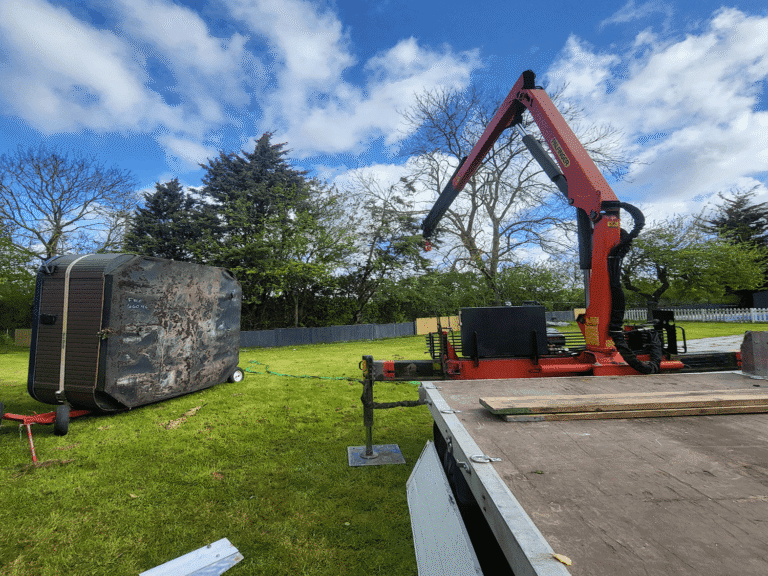
A tracked carrier can help move heavy loads across suitable ground-level routes. A spider crane or HIAB may be considered where the hot tub needs to travel over a wall, fence or other obstacle.
Not every difficult-access move needs a crane. Our guide to using a spider crane to lift a hot tub explains when lifting is suitable and how it differs from ground-based equipment.
Can A Hot Tub Be Lifted Over A Wall Or House?
Some hot tubs can be lifted over walls, fences, garden buildings, or parts of a property when there is no safe ground-level route.
A lift requires more than enough reach. We also need a suitable place for the lifting equipment, safe ground conditions, a clear lifting route and enough room to land and control the hot tub.
The Health and Safety Executive’s guidance on planning lifting operations explains that lifting work should be properly planned, appropriately supervised and carried out safely. The equipment, people and planning required should reflect the difficulty and risks of the lift.
This is why we assess specialist lifting work carefully rather than making assumptions based on a single photograph.
What Photos Should You Send For A Hot Tub Moving Quote?
Photos and a short video can give us a much clearer understanding of the job.
Please try to show:
- The full hot tub from several angles
- The space immediately around it
- The route from the hot tub to the gate
- Every narrow section and tight corner
- Steps, slopes, decking and surface changes
- Walls, fences and overhead obstructions
- The side gate open, ideally with a tape measure visible
- The driveway, road and likely vehicle position
- The access and final position at the new address
A continuous video walking along the route can be particularly useful. It shows the relationship between each obstacle and helps us understand the available turning space.
We may still recommend a site visit for a complex lift, but good photos usually help us provide useful initial advice.
Does A Hot Tub Need To Be Drained And Disconnected?
Yes. The hot tub should normally be fully drained and safely disconnected before it is moved.
Remove the cover, steps, filters, headrests and loose accessories. Standing water should also be cleared where possible.
A plug-in hot tub can usually be switched off and unplugged once it has shut down correctly. A hard-wired electrical supply should be disconnected safely by a qualified electrician.
Our guide explains how to disconnect a hot tub for removal, including what homeowners should prepare and what should be left to a professional.
Never attempt to move a hot tub while it still contains water. The added weight makes the move far more difficult and can place unnecessary strain on the shell and equipment.
Preparing The Route Before We Arrive
Once we have agreed on the moving plan, remove loose items from the access route. This may include furniture, plant pots, bins, toys and garden ornaments.
Please keep children and pets away from the working area. Vehicles should also be moved if they block the access or loading position.
Do not dismantle fencing, decking or other structures unless this has been discussed beforehand. We may find a safer route that avoids unnecessary work.
Need Help Assessing Your Hot Tub Access?
Send us photos or a short video of your hot tub and the full access route. We will review the position, measurements and possible obstacles before recommending the most suitable moving method.
We provide hot tub relocation, transport, removal and difficult-access solutions across Essex, Kent and the South East.
Contact South East Hot Tubs for a free quote and practical advice from our team.
Hot Tub Access Requirements FAQs
Can A Hot Tub Fit Through A Standard Side Gate?
It depends on the hot tub dimensions, the clear gate opening and the space available to turn the tub. The gate may be wide enough, while another part of the route is too restricted. Send us measurements and photos so we can assess the full access.
Can You Move A Hot Tub Through A House?
Some hot tubs can be moved through a property, but the route must have enough width, height, and turning space. Flooring, walls, glass and door frames also need protection. We assess indoor routes carefully before confirming whether this method is suitable.
Will I Need A Crane To Move My Hot Tub?
Not necessarily. Many tubs can be moved using ground-level equipment where the access is suitable. A spider crane, HIAB or another lifting solution may be needed when walls, fences or other obstacles block the route.
Can You Quote From Photographs?
We can often provide useful initial advice from clear photos, measurements and a video. Complex access or crane-assisted work may require further checks or a site visit before the method is confirmed.
Do You Provide Free Quotes?
Yes. Send us the hot tub details, postcode, measurements and access photos, and we will review the job before providing a free quote.